
How to use Microsoft’s new Windows File Recovery Tool
Here’s a great news for Windows 10 users: Microsoft has just released a new free built-in Windows File recovery app which is available in the Microsoft Store. With the new recovery tool, you will be able to recover lost files that cannot be recovered from the Recycle Bin.
This new feature has been introduced only for the Windows 10 version 2004 or newer. So, if your Windows OS is not updated, you need to update it now to get it.
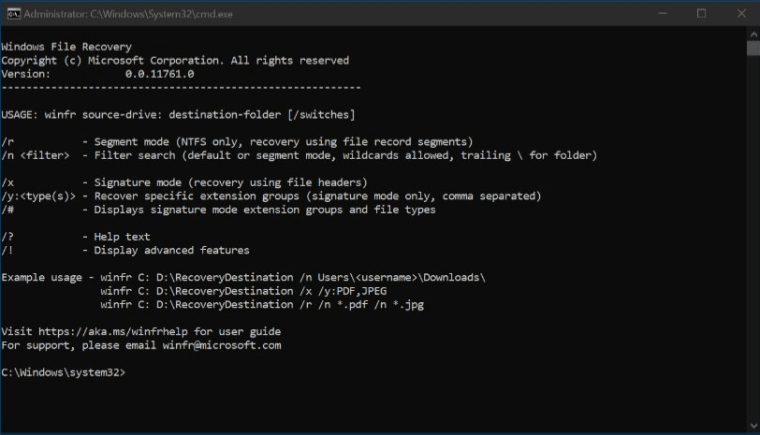
Windows File Recovery is a command-line based application that can be downloaded directly from Microsoft store. This tool works for all types of local storage devices including internal drives, external drives and USB storage devices.
Here are the different use cases when the app can be of use:
- If you have accidentally deleted an important file
- You have deleted a file with the shift+D switch that removes it from Recycle Bin as well
- Hard drive has been wiped clean
- Windows or Hard Drive has corrupted data
The Three Modes of Windows File Recovery
Windows supports different types of File systems belonging to different types of storage devices. Here’s a quick summary of the different file systems support by Windows:
| File Systems | OS and Device Types |
| FAT and exFAT | USB drives, Flash drives, SD Cards (Less than 4 GB) |
| ReFS | Windows Servers and Windows Workstations (Pro) |
| NTFS | Internal HDD, SDD, External Drives, USB and SD Cards having Greater than 4 GB storage capacity |
The tool supports three modes of operation. Here’s a brief description for all three modes:
- Default Mode: Default mode uses the Master File Table (MFT) to locate the lost files. It works best for files that were deleted recently. It only support the NTFS file system.
- Segment Mode: This mode does not require MFT, it only requires segments of data. It works best for situations when the data was deleted a while ago or after the disk was formatted. It also works for recovering data from corrupt drives.
- Signature Mode: Signature mode works for both types of partitions, i-e FAT, ReFS, exFAT and NTFS. This mode only works for large files and searches for specific file types. Data from external storage devices and USB devices can only be recovered with Signature mode.
Here are the different types of data that can be recovered with this tool (audio, video, photos, documents, archives):
- wma, wmv, asf
- jpg, jpeg, jpe, jif, jfif, jfi
- mp3
- mpeg, mpg, mp4, m4v, m4a, m4r, m4b, mov, 3gp, qt
- png
- zip
- xlsx, pptx, docx, odp, ods, ott, otg, otc, ots, otf, oth
Steps to Recover Deleted Files in Windows 10
Here’s how you can use the new Windows File Recovery tool to recover the deleted data:
[mai mult...]